Bedtime fading: An evidence-based, step-by-step guide (with examples)
© 2022 Gwen Dewar, all rights reserved
 opens Prototype file
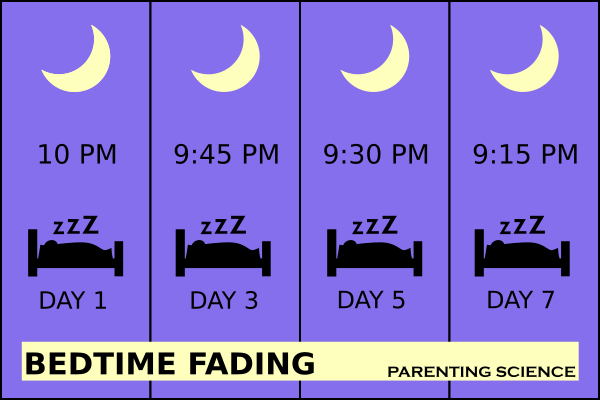
Bedtime fading is a gentle, "no weep" technique for re-adjustment your child's internal clock with the bedtime you desire. You beginning past asking your child to go to bed late — late enough that your child experiences a powerful physiological urge to sleep. Then, over multiple days, you gradually adjust your child's schedule, until your child is falling asleep at the earlier time you prefer.
Studies advise it's an effective way to overcome a child'southward chronic resistance to going to bed. It'due south also useful for getting a child ready for a new, earlier schedule.
But who is a good candidate for this approach? What makes it dissimilar from other forms of sleep training? And what procedures should you follow to maximize success?
This Parenting Science guide offers answers — and detailed instructions.
Who should endeavor this technique?
Bedtime fading has been used on toddlers and preschoolers. It'southward been used on typically-developing children, and on kids with developmental disorders. Simply information technology isn't for every family.
To exist successful, y'all need to invest some fourth dimension in learning the concepts, analyzing your child's current slumber habits, and troubleshooting. You lot also need to be set up to brand some of import changes.
For example, you lot'll need to take steps to reprogram your child's circadian rhythms.
You'll besides demand to change any environmental or lifestyle factors that are keeping your child warning at dark.
And you'll have to exist ready for some short-term difficulties, including setbacks, and daytime tiredness.
But if you're willing to make the endeavor, y'all're likely to see improvements. As I note at the terminate of this article, studies suggest that bedtime fading is effective. Kids adapt to earlier bedtimes — falling asleep more easily and quickly.
Is bedtime fading a form of slumber training? Does it have anything to with "cry it out" techniques? Or the Ferber Method? How is bedtime fading different?
Bedtime fading can exist considered a class of sleep preparation, only it'southward a very dissimilar arroyo.
First, information technology'south designed specifically for improving compliance at bedtime. It's not focused on solving other sleep problems, like frequent night wakings.
Second, information technology doesn't involve leaving children alone to cry. If that happens, you're doing it wrong.
Third — and most chiefly — bedtime fading is different because it addresses the physiological causes of bedtime resistance.
"Weep it out" techniques and the opens in a new windowFerber Method are designed merely to make children stay quiet during the dark. They do not teach kids how to fall comatose, and they exercise nothing to ensure that a kid will become physiologically drowsy at bedtime.
By contrast, bedtime fading is designed to change the brain's internal clock. Information technology gives children the biological tools they demand to fall comatose promptly — without protest.
So what are the crucial groundwork concepts? What do parents need to know before get-go the procedure?
The bedtime fading technique was adult by ii professors of pediatrics, Cathleen Piazza and Wayne Fisher, and it's based on solid principles of sleep science and learning theory.
If yous understand this background, the program'due south steps will make sense to you, and you'll be able to tailor the method to the specific needs of your child. Here are the key concepts.
1. To fall comatose, people must feel physiological drowsiness. So if a child isn't falling asleep promptly at bedtime, this is a sign that the child isn't drowsy enough. Something is getting in the mode.
What'south causing the lack of drowsiness? Equally I explain elsewhere, kids fail to become sleepy for a diverseness of reasons. Here are some of the virtually mutual culprits:
- The child's cyclic rhythms are out-of-sync with the parent'due south preferred bedtime. The kid's "internal clock" isn't triggering the correct brain chemistry as bedtime approaches, and so the child isn't physiologically capable of falling comatose.
- The child isn't experiencing enough of what scientists call "sleep pressure," i.e., too little time has passed since the child last slept, then he or she isn't capable of feeling drowsy yet.
- The child suffers from nighttime anxieties or fear of the dark.
- The child is encountering too much psychological stimulation before bedtime; e.m., opens in a new windowtoo much television.
- The kid's daily experiences have trained him or her to acquaintance bedtime with disharmonize, stalling, and a failure to fall asleep. As bedtime approaches, the kid anticipates trouble, and this anticipation blocks drowsiness.
This list isn't complete, and information technology'south likely that your child is experiencing more than i of these problems.
Indeed, no matter what else is going on, it'south a good bet that your kid is afflicted by the last trouble on the list — learned, negative, bedtime associations.
The very fact that you've been trying to enforce a particular bedtime — trying and failing — suggests that all those nighttime struggles have turned into a kind of nightly routine for your child. Your child has adult a addiction of bedtime sleeplessness.
Just the cardinal signal is that something is actively preventing your child from feeling sufficiently drowsy and peaceful at bedtime. If you want your child to acquire how to autumn asleep easily and promptly, you lot need to eliminate these barriers.
2. Your child can brand a breakthrough if you "reboot" your current routine.
Y'all demand to get rid of those negative bedtime associations and replace them with positive ones. You demand to help your child acquire that bedtime is a time of peacefulness, security, and powerful drowsiness.
Depending your child'southward individual circumstances, this might mean eliminating a late afternoon nap; fugitive potentially disturbing or exciting television programs before bedtime; or addressing your child's night fears.
Merely whatever else you do, you lot should immediately cease trying to enforce your current, official bedtime. Instead, you should supervene upon information technology with a later bedtime — a bedtime late enough that your child volition experience powerful, physiological drowsiness.
This should make information technology easy for your child to autumn asleep, promptly and without stalling tactics. And once your child has formed these new, positive slumber associations, you lot'll be ready to motility into the fading phase of preparation — the phase where you gradually move your kid'south bedtime dorsum to the earlier fourth dimension you adopt.
3. After your kid has experienced success with the new, later bedtime, you can utilise circadian cues — and incremental, nightly shifts — to suit your kid to the before bedtime you prefer.
If you've e'er had jet lag, you know how it works. We don't instantly adjust to an before bedtime — not if the bedtime is substantially out-of-sync with our internal clock. But it'due south pretty easy to get at that place in small steps — i.eastward., by going to bed 15 minutes earlier each night.
Then this is the approach parents use in bedtime fading — in combination with providing kids with crucial environmental cues for reprogramming their circadian rhythms.
The gradual stride is crucial, considering you don't desire to re-establish those negative sleep associations. If, at whatsoever bespeak along the mode, your kid has trouble falling asleep promptly (within fifteen minutes of bedtime being appear), your kid is at risk for re-learning that bedtime is hard, unpleasant, or an occasion for stalling.
For this reason, Piazza and Fisher incorporate astern steps in their program. When a kid doesn't adjust to the latest incremental change — i.e., when the child fails to autumn asleep promptly later on you've rescheduled bedtime for 15 minutes earlier — you lot don't go along pushing alee. Instead, you immediately revert to the later bedtime.
How do you lot really implement bedtime fading? Here's a step-by-stride guide, with examples.

one. Judge your kid'south sleep needs, and set a realistic goal for your child'due south bedtime and morning time wake-up fourth dimension.
For assist, review the recommended sleep times for individuals in your child'due south age subclass. In addition, consider how your kid actually performs and functions. Some kids need more slumber than their peers do. Others need less.
Example (toddler): Sophie is eighteen months onetime. Most children her age need 11-14 hours of full sleep each day, including naps. A few kids thrive on as petty as 9-10 hours of total sleep. Some may demand up to 15 hours.
Based on observation, Sophie's parents judge that she needs well-nigh fourteen hours of sleep to feel cheerful, alert, and salubrious. Sophie takes naps each day, accounting for about two hours of slumber. So she needs to sleep approximately 12 hours at night.
Sophie's parents desire her to awaken each morning at 7am, then they prepare their goal bedtime for 12 hours earlier — at 7pm.
Example (preschooler): Mario is iv years old, and he no longer takes naps, so he must come across all his slumber needs at night. Experts recommend that kids Mario's age get approximately ten-13 hours of total sleep time. They also acknowledge that some kids seem to do well when they fall an hour outside of this range.
Subsequently observing his behavior, Mario'southward parents estimate that he requires almost x hours of sleep. They desire him to wake upward each morning at vi:30am, so they decide that his goal bedtime is 10 hours earlier — at 8:30pm.
two. Address factors that might interfere with your child's ability to become drowsy at the desired bedtime.
Is your kid taking naps too late in the day? Does your child eat caffeine? Is your child exposed to bright light in the evening, or besides little bright light in the morning time? This opens in a new windowParenting Science commodity virtually bedtime issues can assist you troubleshoot.
Example (toddler): Sophie has been napping each day after 4pm. This is reducing slumber pressure in the evening, so her parents reschedule her afternoon nap so that it ends by 3pm.
Example (preschooler): Mario is in the habit of playing video games immediately before bedtime. The excitement — and bright light emitted by his device — might be delaying drowsiness. So his parents implement a new rule: No video games during the hr before bedtime.
iii. Figure out when your child is currently in the addiction of falling asleep each night, and then pick a new bedtime that is 15 to 30 minutes later.
Instance (toddler): The ultimate goal for Sophie's parents is a 7pm bedtime, just right now she falls brusk of this goal: Sophie doesn't typically fall comatose each night until 7:45 pm. So Sophie's parents reschedule bedtime for 8pm.
Example: Mario's parents want him to fall comatose each night at 8:30pm. Just currently, Mario doesn't autumn asleep each night until approximately 10pm. Then Mario's parents reschedule his bedtime for 10:15pm.
iv. Keep your child awake (with calm, pre-slumber activities) until the newly-appointed bedtime arrives.
Why? Recall: Until now, your child has been associating bedtime with conflict, alertness, or a failure to fall asleep. Yous want to assistance your child to learn a new association — one that connects bedtime with an piece of cake transition to sleep. If your child falls asleep before bedtime, you'll have missed that learning opportunity.
5. Observe how your child responds to the new bedtime. How long does it take your child to autumn asleep? And make the appropriate adjustments.
If your kid falls comatose within 15 minutes, remain on this new schedule for one additional night.
Example: Bedtime is announced at 10:15pm, and Mario falls asleep inside 15 minutes. The next night, Mario'due south parents keep with the x:15pm bedtime.
If your child takes more than than xv minutes to fall asleep, make an adjustment: On the following dark, make bedtime even afterward (by 15 to 30 minutes).
Example: Bedtime is announced at ten:15pm, but Mario stays awake until x:40pm. So the next night, Mario's parents denote bedtime at 10:30pm.
5. Once your child has experienced two consecutive nights of success with the aforementioned bedtime — falling asleep within fifteen minutes — introduce a slightly earlier bedtime.
Instance: Bedtime is set for 10:15pm, and for two nights in a row, Mario falls asleep promptly. So on the following night, Mario'southward parents set bedtime for 10pm.
6. Throughout this process, expose your child to crucial circadian cues. Awaken your child at the same time each morning — the wake-upward time you identified every bit your goal.
Piazza and Fisher recommend that you practise this, even if it means your child won't get plenty slumber for the day. Why?
You're trying to reprogram your kid's cyclic rhythms — to shift your kid'southward "internal clock" to an earlier schedule. And exposing your child to forenoon light — at the same time each day — is one of the well-nigh powerful tools for achieving this. (Read more about this in my article opens in a new windowhere.)
Moreover, if your child misses some slumber as a result, it tin can assist speed up your child's aligning to the new schedule. Your kid will build up more sleep pressure during the day, increasing his or her drowsiness at night.
What if your child has been in the habit of waking up much later? What if your goal wake-upwardly time leaves your child too sleepy to part?
In this case, I think you need use your own judgment. It makes sense to me to avoid imposing a wake-up time if it would cause your child to lose more than an hr of slumber. You can make it at your goal in steps.
Example: Mario is accustomed to waking up at viii:30am — two hours later than his goal wake-up time! That'southward a big gap, so his parents decide to modify the official process. Instead of waking him at six:30am, they brainstorm the training by awakening him each morning at 7:15am. And then, over several days, they gradually shift Mario'south wake-up time to vi:30 am.
7. Continue with bedtime fading — making appropriate adjustments from nighttime to night — until you've reached your goal bedtime.
How long this will this take? That depends on many factors, including the gap you're trying to close. If you're trying to get your child to fall asleep 30 minutes earlier at night, information technology might only take a few days to achieve your goal. If you're trying to make an adjustment of more than one hour, training might continue for up to 2 weeks.
And what exactly practice studies tell us? What is the show that bedtime fading really works?
First, there is prove from a study of bedtime tantrums. Researchers randomly assigned 36 immature children to receive one of three experimental conditions:
- a program of Ferber method sleep preparation;
- a program that combined bedtime fading with the implementation of a pleasant, pre-bedtime routine (like taking a bath, and then reading a story); and
- a command condition.
Subsequently half-dozen weeks, kids in the two treatment programs experienced fewer tantrums than children in the control group did (Adams and Rickert 1989).
Then we have evidence of a somewhat dissimilar kind — studies that aren't randomized, and don't include control groups. Instead, researchers treat all participants the aforementioned way, and meet if the treatment is linked with any changes.
In these studies, kids' sleep habits are monitored earlier they begin bedtime fading, and then once again later they've completed the program. And the outcomes are proficient.
For case, one of the biggest of these studies tracked the progress of 21 preschoolers in Australia. The children all had sleep problems — difficulty initiating slumber, trouble with frequent night wakings, or a combination of both. What happened?
It'due south not clear that bedtime fading had whatever impact on night wakings, simply researchers observed rapid improvements in
- the fourth dimension it took kids to fall asleep at bedtime;
- the frequency of bedtime tantrums; and
- the total time kids spent awake at night, after falling asleep.
Before handling, kids had taken an average of 23 minutes to fall asleep at bedtime. 2 weeks late, this average had dropped to 12 minutes.
Among children who had been throwing bedtime tantrums, parents reported an average drop from ane.7 per week to 0.iv per week.
And full time spent awake at night (later on sleep onset) had decreased likewise, from an boilerplate of 32 minutes to 24 minutes (Cooney et al 2018).
Other, smaller studies have tested variants of bedtime fading and reported like results. Children end up falling asleep more than speedily at bedtime, they become more sleep overall, and parents tend to study high satisfaction with the method (e.yard., Piazza and Fisher 1991a; Piazza and Fisher 1991b; Piazza et al 1999; Sanberg et al 2018; Delamere et al 2018).
Where can I learn more nigh shifting my kid's "internal clock"? And other means to improve my kid's sleep habits?
Check out my commodity, opens in a new window"How to reset your child's internal clock for an earlier bedtime."
In add-on, I recommend these Parenting Scientific discipline articles:
- opens in a new window"How to solve bedtime problems in children: Solutions for the science-minded"
- opens in a new window"15 babe sleep tips: Evidence-based advice for calmer, quieter, more restful nights"
- opens in a new window"Tech at bedtime: Do electronic devices cause sleep problems in children?"
- opens in a new window"Baby sleep deprivation: How to tell if your baby isn't getting plenty sleep"
- opens in a new window"Signs of sleep deprivation in children and adults"
References: Bedtime fading
Adams LA and Rickert VI. 1989. opens in a new windowReducing bedtime tantrums: Comparison between positive bedtime routines and graduated extinction. Pediatrics 84(v): 756-761.
Cooney MR, Brusque MA, Gradisar K. 2018. opens in a new windowAn open trial of bedtime fading for slumber disturbances in preschool children: a parent group education approach. Sleep Med. 46:98-106.
Delemere East, Dounavi K. 2018. Parent-Implemented Bedtime Fading and Positive Routines for Children with Autism Spectrum Disorders. J Autism Dev Disord. 48(four):1002-1019.
Piazza CC and Fisher West. 1991a. A faded bedtime with response price protocol for treatment of multiple sleep issues in children. J Appl Behav Anal. 24(1):129-twoscore.
Piazza CC, Fisher WW. 1991b. Bedtime fading in the treatment of pediatric insomnia. J Behav Ther Exp Psychiatry. 22(1):53-6.
Piazza CC, Fisher WW, and Sherer M. 1997. Treatment of multiple sleep problems in children with developmental disabilities: faded bedtime with response cost versus bedtime scheduling. Dev Med Child Neurol. 39(6):414-8.
Sanberg SA, Kuhn BR, Kennedy AE. 2018. Outcomes of a Behavioral Intervention for Sleep Disturbances in Children with Autism Spectrum Disorder. J Autism Dev Disord. 48(12):4250-4277.
Epitome credits:
Title infographic by Parenting Science
Epitome of girl under covers by Liderina / istock
Source: https://parentingscience.com/bedtime-fading/
0 Response to "Bedtime fading: An evidence-based, step-by-step guide (with examples)"
Postar um comentário